Catalunya tourist information
Tourist and travel info about Catalunya!


A Boston reporters view on Catalunia:
SITGES, Spain -- As I tuck into a magnificent lunch of seafood paella at the Mare Nostrom restaurant, I know I have found my spot. On the patio, a gentle breeze stirs the table linen and I look across the street to the glistening beach.
This is my kind of town -- beaches, shops, restaurants, cafes, museums. Sitges, on Spains east coast, is Catalonias premier resort town, situated on the Costa Dorada (Gold Coast) 20 minutes south of Barcelona. In summer, its population swells from 17,000 to 60,000 as visitors come to relax, dine and party.
For more than a century, Sitges has been a popular spot for writers, intellectuals and artists seeking inspiration for their work. In the 1890s, the town was a mecca for Modernist artists such as Santiago Rusinol, who died in 1931. His house and studio are now the Cau Ferrat museum and house his eclectic collection of wrought iron, ceramics, sculptures and paintings. Set against electric blue walls, highlights include Picassos and two Grecos, as well as Rusinols own striking paintings and an incredible view of the Mediterranean.
Cau Ferrat is one of three museums in town -- the Maricel and the Romantic are the other two -- all definitely worth a visit. So are the shops, offering everything from jewelry to clothes, shoes and books, plus the usual tourist items. Mixed in are plenty of bars and cafes, where you can take a break from shopping over an espresso and pastry.
In the evening, the place is jumping with those who like to party. The Spanish eat dinner late, so its not unusual to walk into a restaurant at 10 p.m. and be the first ones there. Restaurant Maricel, along the main waterfront strip, is expensive but worth the coin.
The region of Catalonia is a nation within a nation. While part of Spain, it has its own semi-autonomous government. Catalan -- a Romance language akin to the Provencal of France -- is spoken everywhere, supplanting Castilian Spanish as the main language eve on streets signs. Catalonians are proud of their distinct culture and heritage; with their long seafaring tradition and centuries of trade, there is a strong connection between it and southern France.
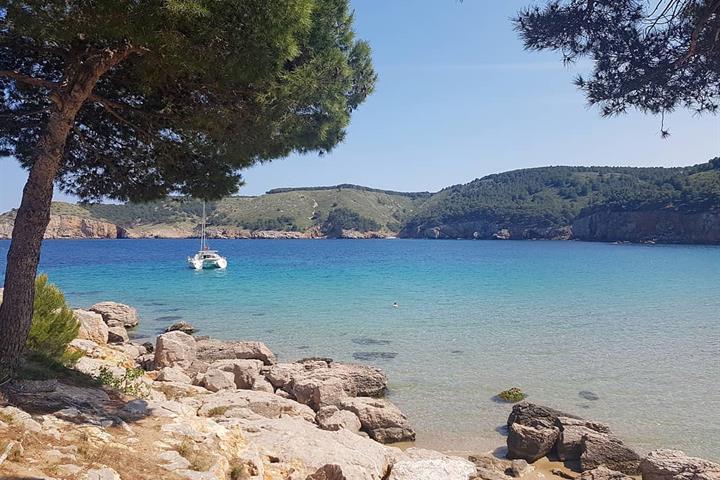
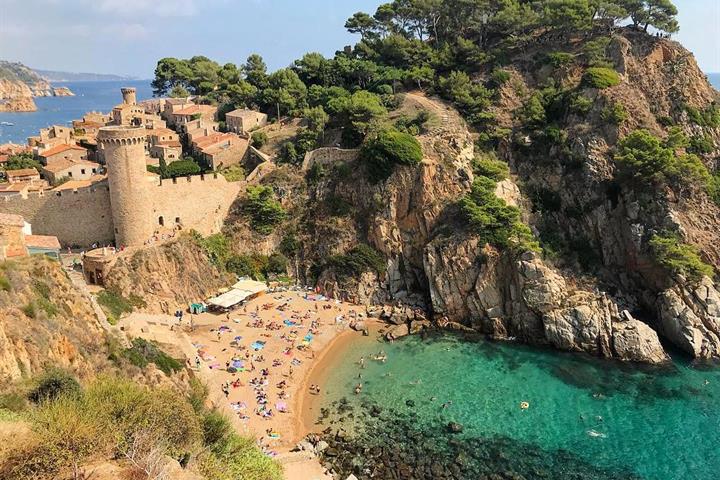
While I am convinced Sitges is the place for me, this is before I meet and fall for the rugged coastal towns of the Costa Brava (Wild Coast), north of Barcelona. Tucked into the crenellated coastline are charming seaside towns such as Cadaques, Roses, Palafrugell and Tossa de Mar. Picking a favorite now is all but impossible.
This area, particularly Cadaques and the little fishing village of Port-lligat, is well-known as the stomping grounds for one of this centurys greatest painters, Salvador Dali. While Dali and his wife, Gala, had a summer home at Cadaques, his home and studio at Portlligat (now open to the public) were his haven, where he painted the majority of his great works.
Inside, furnishings and decoration are as they were when Dali was alive. (He died in 1989.) Walk into his studio, and you can picture the eccentric master sitting at his easel, drawing inspiration from the picturesque view out the window. Further inland at Figueres is The Dali Theatre-Museum, which houses a great many of his works. He is also buried at the museum.
Tracing the paths of history through Catalonia is an intriguing activity. The Romans first arrived in Spain along this coast and established a base at Tarragona for their conquest of the Iberian Peninsula. They sure knew how to pick the right spot. They situated their amphitheatre right on the shore and its remains are still an impressive sight against the beautiful blue backdrop of the Mediterranean.
Much of the Roman remains have been incorporated into the city over the centuries: An apartment building and other homes have been constructed right into or over the Roman circus, built in the first century AD. Archeological work at the circus is an ongoing project, with many of its cavernous passageways excavated, and three of its 63 gates preserved.
You can walk along a 1-km stretch of the Roman wall. Behind it is the 12th-century cathedral built on the site of a Roman temple to Jupiter and a subsequent Arab mosque. (Apparently, Jupiter was so enamored with Tarragona that he abandoned his mortal wife, Tyria, when the city cast a spell on him.)
At another site at Empuries, Roman and Greek efforts combined to create an important coastal trading centre. The Greeks arrived first in the early 6th century BC and named the colony Emporion, which means "market" in Greek. The Romans arrived in 218 BC and set up a military base, and by 100 BC, a new Roman city was established and linked to the Greek centre. Archeologists have learned much from this site and there is an excellent museum (and film) to explain it.
Empuries was a sophisticated city, complete with temples, forum, amphitheatre, shops and extensive housing. In the Roman quarter, dont miss the beautiful mosaics that decorated the floors of one of the largest houses in the city.
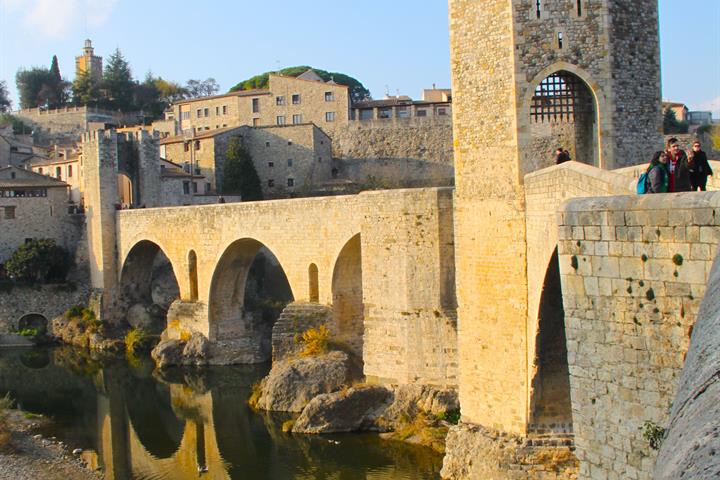
Catalonia is rich in medieval sites; one of the most striking is the town of Besalu. Approach the village across the 14th-century Gothic bridge over the Fluvia river -- it makes an impressive entrance. The village was the centre of an independent earldom during the Middle Ages. A toll was collected to enter town and the money used to pay for the bridge and the towns seven churches.
Many of the towns buildings are Romanesque. A particularly fine example is St. Peres church, built in 977 and the sole remnant of Besalus Benedictine monastery. Two lions decorating its entrance symbolize strength and loyalty.
Besalu used to be a stopping point on the pilgrimage route to Santiago de Compostella and has enjoyed a special role as a religious centre. Its most recent find, in 1964, was a Jewish bath (mikvah) dating back to AD 1250. Made of stone, the sunken bath (found by a man digging a well) was originally filled by spring water. Its the first Jewish bath found in Spain, and only the third in all of Europe.
The Romans werent the only ones who understood the value of a good location. The Poblet Monastery near Montblanc proves the Cistercian monks knew this as well. Poblet Monastery, still a haven of tranquility, was the first and most important of three sister monasteries, known as the Cistercian triangle, that helped consolidate power in Catalonia in the 12th century. (The other two are Villbona de les Monges and Santes Creus, the last probably the prettiest of the three.)
But Poblet is the most impressive. The view from the road shows how the abbey is enclosed by fortified walls that have hardly changed since the Middle Ages. Interior highlights include the vaulted cloisters built in the 12th and 13th centuries (the capitals beautifully decorated with carved scrollwork), a high altar built of alabaster and carved in 1527, and the very detailed carved tombs of a number of kings from the 12th to 15th centuries. Monks were forced out of Poblet in 1835; the order returned in 1940.
Today, only about 25% of the site is open to the public, the remainder reserved for the monks who live there.
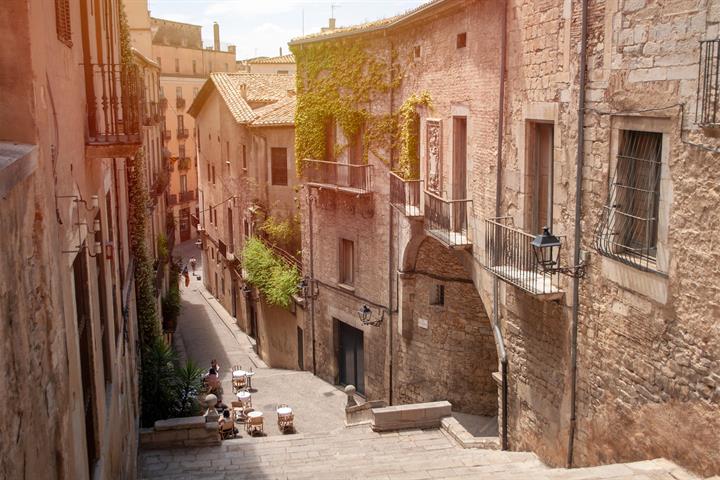
Probably Catalonias second city after Barcelona, Girona is a cosmopolitan centre with smart shops and smartly-dressed people. It has a modern, energetic atmosphere I found nowhere else outside Barcelona. But amidst the hustle and bustle of the current city is a story that goes back to Roman times. Evidence of Roman occupation of Girona still can be seen along the Archeological Walk, which runs right around the city. Girona Cathedral is worth a visit to see its Catalan Baroque and Gothic architecture, as well as the treasures contained within its museum, especially the 10th-century illuminated copy of St. Beatus Commentary on the Apocalypse, and the 11th- to 12-century Tapestry of the Creation, its colors still rich after all these years.
Girona also boasts an extensive Jewish heritage, the result of a 600-year established community. From AD 890 to 1492 (when Ferdinand and Isabelle ordered the expulsion of Jews from Spain), a vibrant community of up to 300 Jewish people called Girona home. Centred around the narrow and winding streets of the Jewish Quarter, a museum and library are being established to record the story. Its part of an on-going project to rehabilitate the Jewish neighborhood by opening up streets and houses to people again. Girona is linked with eight other Spanish cities (including Cordoba, Segovia and Toledo) that create a route of Jewish settlement which visitors can trace.
A popular getaway from Girona (about halfway to Besalu) is Lake Banyoles. Its an ideal picnic spot and was the site for the 1992 Olympic rowing competitions. If a more modern excursion is what youre looking for and you just cant stay away from theme parks -- even in Europe -- then youll want to check out Port Aventura, near the popular resort town of Salou (about an hour south of Barcelona).
Just two years old, Port Aventura (partly owned by the Tussaud Group and Anheuser Busch) boasts different areas (such as Mediterranean, Polynesia, China and Mexico) that offer themed amusements and shows. The park has 28 rides (trains, catamarans, a gondola, log flume and other water rides), but it is the Dragon Khan which gets most of the attention. The coasters eight loops have won it a place in The Guinness Book of World Records, and it propels passengers at speeds of up to 110 km/hr.
You can easily spend a day or two here, enjoying the fun.
SITGES, Spain -- As I tuck into a magnificent lunch of seafood paella at the Mare Nostrom restaurant, I know I have found my spot. On the patio, a gentle breeze stirs the table linen and I look across the street to the glistening beach.
This is my kind of town -- beaches, shops, restaurants, cafes, museums. Sitges, on Spains east coast, is Catalonias premier resort town, situated on the Costa Dorada (Gold Coast) 20 minutes south of Barcelona. In summer, its population swells from 17,000 to 60,000 as visitors come to relax, dine and party.
For more than a century, Sitges has been a popular spot for writers, intellectuals and artists seeking inspiration for their work. In the 1890s, the town was a mecca for Modernist artists such as Santiago Rusinol, who died in 1931. His house and studio are now the Cau Ferrat museum and house his eclectic collection of wrought iron, ceramics, sculptures and paintings. Set against electric blue walls, highlights include Picassos and two Grecos, as well as Rusinols own striking paintings and an incredible view of the Mediterranean.
Cau Ferrat is one of three museums in town -- the Maricel and the Romantic are the other two -- all definitely worth a visit. So are the shops, offering everything from jewelry to clothes, shoes and books, plus the usual tourist items. Mixed in are plenty of bars and cafes, where you can take a break from shopping over an espresso and pastry.
In the evening, the place is jumping with those who like to party. The Spanish eat dinner late, so its not unusual to walk into a restaurant at 10 p.m. and be the first ones there. Restaurant Maricel, along the main waterfront strip, is expensive but worth the coin.
The region of Catalonia is a nation within a nation. While part of Spain, it has its own semi-autonomous government. Catalan -- a Romance language akin to the Provencal of France -- is spoken everywhere, supplanting Castilian Spanish as the main language eve on streets signs. Catalonians are proud of their distinct culture and heritage; with their long seafaring tradition and centuries of trade, there is a strong connection between it and southern France.
While I am convinced Sitges is the place for me, this is before I meet and fall for the rugged coastal towns of the Costa Brava (Wild Coast), north of Barcelona. Tucked into the crenellated coastline are charming seaside towns such as Cadaques, Roses, Palafrugell and Tossa de Mar. Picking a favorite now is all but impossible.
This area, particularly Cadaques and the little fishing village of Port-lligat, is well-known as the stomping grounds for one of this centurys greatest painters, Salvador Dali. While Dali and his wife, Gala, had a summer home at Cadaques, his home and studio at Portlligat (now open to the public) were his haven, where he painted the majority of his great works.
Inside, furnishings and decoration are as they were when Dali was alive. (He died in 1989.) Walk into his studio, and you can picture the eccentric master sitting at his easel, drawing inspiration from the picturesque view out the window. Further inland at Figueres is The Dali Theatre-Museum, which houses a great many of his works. He is also buried at the museum.
Tracing the paths of history through Catalonia is an intriguing activity. The Romans first arrived in Spain along this coast and established a base at Tarragona for their conquest of the Iberian Peninsula. They sure knew how to pick the right spot. They situated their amphitheatre right on the shore and its remains are still an impressive sight against the beautiful blue backdrop of the Mediterranean.
Much of the Roman remains have been incorporated into the city over the centuries: An apartment building and other homes have been constructed right into or over the Roman circus, built in the first century AD. Archeological work at the circus is an ongoing project, with many of its cavernous passageways excavated, and three of its 63 gates preserved.
You can walk along a 1-km stretch of the Roman wall. Behind it is the 12th-century cathedral built on the site of a Roman temple to Jupiter and a subsequent Arab mosque. (Apparently, Jupiter was so enamored with Tarragona that he abandoned his mortal wife, Tyria, when the city cast a spell on him.)
At another site at Empuries, Roman and Greek efforts combined to create an important coastal trading centre. The Greeks arrived first in the early 6th century BC and named the colony Emporion, which means "market" in Greek. The Romans arrived in 218 BC and set up a military base, and by 100 BC, a new Roman city was established and linked to the Greek centre. Archeologists have learned much from this site and there is an excellent museum (and film) to explain it.
Empuries was a sophisticated city, complete with temples, forum, amphitheatre, shops and extensive housing. In the Roman quarter, dont miss the beautiful mosaics that decorated the floors of one of the largest houses in the city.
Catalonia is rich in medieval sites; one of the most striking is the town of Besalu. Approach the village across the 14th-century Gothic bridge over the Fluvia river -- it makes an impressive entrance. The village was the centre of an independent earldom during the Middle Ages. A toll was collected to enter town and the money used to pay for the bridge and the towns seven churches.
Many of the towns buildings are Romanesque. A particularly fine example is St. Peres church, built in 977 and the sole remnant of Besalus Benedictine monastery. Two lions decorating its entrance symbolize strength and loyalty.
Besalu used to be a stopping point on the pilgrimage route to Santiago de Compostella and has enjoyed a special role as a religious centre. Its most recent find, in 1964, was a Jewish bath (mikvah) dating back to AD 1250. Made of stone, the sunken bath (found by a man digging a well) was originally filled by spring water. Its the first Jewish bath found in Spain, and only the third in all of Europe.
The Romans werent the only ones who understood the value of a good location. The Poblet Monastery near Montblanc proves the Cistercian monks knew this as well. Poblet Monastery, still a haven of tranquility, was the first and most important of three sister monasteries, known as the Cistercian triangle, that helped consolidate power in Catalonia in the 12th century. (The other two are Villbona de les Monges and Santes Creus, the last probably the prettiest of the three.)
But Poblet is the most impressive. The view from the road shows how the abbey is enclosed by fortified walls that have hardly changed since the Middle Ages. Interior highlights include the vaulted cloisters built in the 12th and 13th centuries (the capitals beautifully decorated with carved scrollwork), a high altar built of alabaster and carved in 1527, and the very detailed carved tombs of a number of kings from the 12th to 15th centuries. Monks were forced out of Poblet in 1835; the order returned in 1940.
Today, only about 25% of the site is open to the public, the remainder reserved for the monks who live there.
Probably Catalonias second city after Barcelona, Girona is a cosmopolitan centre with smart shops and smartly-dressed people. It has a modern, energetic atmosphere I found nowhere else outside Barcelona. But amidst the hustle and bustle of the current city is a story that goes back to Roman times. Evidence of Roman occupation of Girona still can be seen along the Archeological Walk, which runs right around the city. Girona Cathedral is worth a visit to see its Catalan Baroque and Gothic architecture, as well as the treasures contained within its museum, especially the 10th-century illuminated copy of St. Beatus Commentary on the Apocalypse, and the 11th- to 12-century Tapestry of the Creation, its colors still rich after all these years.
Girona also boasts an extensive Jewish heritage, the result of a 600-year established community. From AD 890 to 1492 (when Ferdinand and Isabelle ordered the expulsion of Jews from Spain), a vibrant community of up to 300 Jewish people called Girona home. Centred around the narrow and winding streets of the Jewish Quarter, a museum and library are being established to record the story. Its part of an on-going project to rehabilitate the Jewish neighborhood by opening up streets and houses to people again. Girona is linked with eight other Spanish cities (including Cordoba, Segovia and Toledo) that create a route of Jewish settlement which visitors can trace.
A popular getaway from Girona (about halfway to Besalu) is Lake Banyoles. Its an ideal picnic spot and was the site for the 1992 Olympic rowing competitions. If a more modern excursion is what youre looking for and you just cant stay away from theme parks -- even in Europe -- then youll want to check out Port Aventura, near the popular resort town of Salou (about an hour south of Barcelona).
Just two years old, Port Aventura (partly owned by the Tussaud Group and Anheuser Busch) boasts different areas (such as Mediterranean, Polynesia, China and Mexico) that offer themed amusements and shows. The park has 28 rides (trains, catamarans, a gondola, log flume and other water rides), but it is the Dragon Khan which gets most of the attention. The coasters eight loops have won it a place in The Guinness Book of World Records, and it propels passengers at speeds of up to 110 km/hr.
You can easily spend a day or two here, enjoying the fun.
Holiday ideas
Rural homes Spain [1150]
Beach villas Spain [954]
Luxury villas Spain [587]
Beach apartments Spain [1659]
Luxury apartments Spain [525]
Family holidays Spain [2326]
Citybreak Spain [255]
Cheap rentals Spain [220]
Golf homes Spain [1306]
Bed and breakfast Spain [21]
Summer holidays Spain [3465]
Disability holidays Spain [948]
Ski accommodation Spain [36]
Tourist attractions Spain [1177]
Holiday apartments Spain [2099]
Holiday villas Spain [1721]
Walking holidays Spain [709]
Holiday rentals in Catalunya
Rural homes Spain [1150]
Beach villas Spain [954]
Luxury villas Spain [587]
Beach apartments Spain [1659]
Luxury apartments Spain [525]
Family holidays Spain [2326]
Citybreak Spain [255]
Cheap rentals Spain [220]
Golf homes Spain [1306]
Bed and breakfast Spain [21]
Summer holidays Spain [3465]
Disability holidays Spain [948]
Ski accommodation Spain [36]
Tourist attractions Spain [1177]
Holiday apartments Spain [2099]
Holiday villas Spain [1721]
Walking holidays Spain [709]
Holiday rentals in Catalunya